
From the ornate to the minimal, a razzle of Art Deco in Paris
Art Deco, with all its lavish ornamentation, was brought back to life in the last few years with Bad Luhrmann’s “The Great Gatsby” revival and Guillermo del Toro’s “Nightmare Alley” but illustrious buildings like New York’s Empire State and statues like Rio de Janeiro’s Christ The Redeemer have stoked this fire for almost a century.
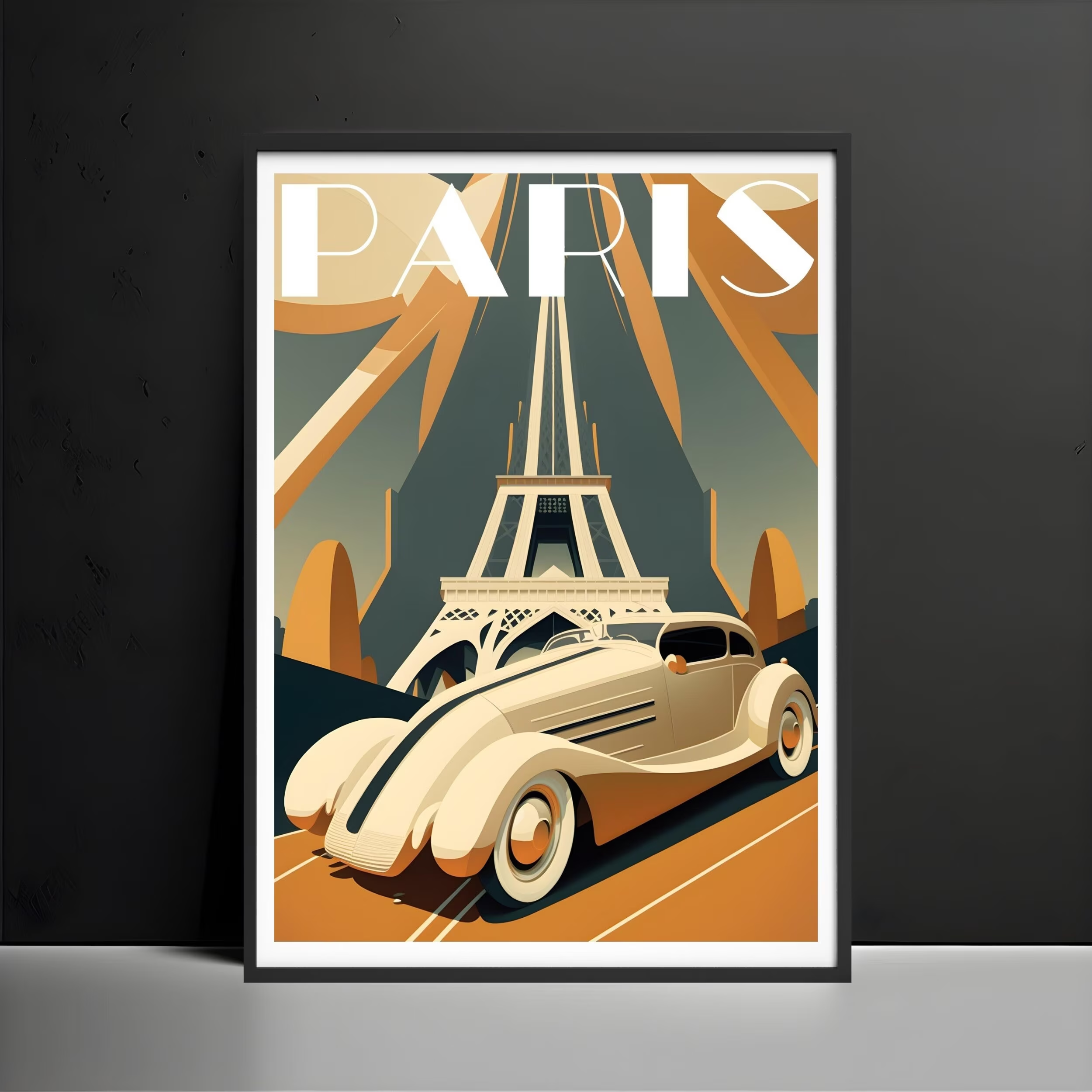
But where you want to uncover Art Deco in all its glam, is Paris. Of course.
Paris may have been called the “city of lights” or a place for lovers, but from an aesthetic perspective it has less of a specific intonation as hundreds of years of design has wafted through here – some enduring, others disappearing forever.
The term “Art Deco” actually only came into use in the 1960s from a book by Bevis Hillier titled “Art Deco” which was an adaptation of “artes decoratifes” from the full name of the 1925 Paris exposition (a specialized exhibition held in the city from April to October 1925 – designed by the French government to highlight the new modern style of architecture, interior decoration, furniture, glass, jewelry and other decorative arts in Europe and throughout the world).

During the period, buildings of this style were simply called modern or modernistic. Art Deco as an architectural style is multi-dimensional, but all with a theme of modernity, rejecting the immediate past and reimagining ancient and exotic motifs. Some of these characteristics may be seen to be mixed and matched, so it can often be difficult to clearly categorize a building by style – but typically they are stylized geometric forms such as zigzags, chevrons, squares within squares, and diamonds. And then there are stylized organic forms mixed with these fabulous geometrics: fern tendrils, flowers of all kinds, and fountains. It’s maximalism for the lover of minimalism.
Art Deco rejected the immediate past but often looked to the distant past for inspiration. Ancient cultures, such as the Egyptian, Mayan, and Assyrian, were stylized and re-imagined. But most of all Art Deco looked to the future, embraced technology and celebrated it. After all this was between wars, a moment of hopefulness.
Now I shall share two rather recently renovated art deco hotels, a reoccurring exhibition dedicated to the craft and a museum housing all this sterling. Because it is Paris that is rousing itself as the fountainhead of all things deco. Yet again.

“Art Deco is one of the most exciting chapters in the history of the decorative arts. Conceived in France before WWI at a time when all creative roads led to Paris; melding Cubism, Constructivism and Futurism”, says Susie Hollands, the founder of Vingt Paris, a full service real estate company. “Paris is still the natural starting point for the connoisseur.”

What Not To Miss If You’re Art Deco Hunting In Paris
Le Palais de Chaillot (1 Place du Trocadéro et du 11 Novembre, 75016) – it played host to the first French retrospective of Art Deco.

Le Palais de la Porte Dorée (293 Avenue Daumesnil, 75012) – Designed by Albert Laprade, now the National Centre for the History of Immigration.

Les Folies Bergère (32 Rue Richer, 75009) – a music hall theater’s bloom from Belle Epoque to Roaring twenties.

Le Grand Rex (1 Boulevard Poissonnière, 75002) – a mockup of the famed Radio City Music Hall of New York all done by cinema producer Jacques Haïk.

Salle Pleyel (252 Rue du Faubourg Saint-Honoré, 75008) – a symphonic concert hall entrusted to architect Jean-Marcel Auburtin, in 1924.

Le théâtre de la Michodière (5 Rue de la Michodière, 75002) – decorated by the famous designer Jacques-Émile Ruhlmann, the red and gold room seating 900 remains an intact jewel of this period.

Le Studio Building (65 Rue La Fontaine, 75016) – one of the last constructions of architect Henri Sauvage, in 1927, now the department store Samaritaine.

L’immeuble de 1934 (3 Boulevard Victor, 75015) – a masterpiece by Pierre Patout and Alfred Lombard, nicknamed “The Liner”.

Le Théâtre des Champs-Élysées (15 Avenue Montaigne, 75008) – a modernist’s finest with Auguste Perret’s concrete façade.

Les Jardins du Trocadéro (Place du Trocadero and the November 11, 75016) – between the Varsovie’s colossal fountain centerpiece (designed to spurt 8240m3 of water an hour) and slopes lined with art deco statues like Traverse’s l’Homme and Bacqué’s la Femme it’s the ultimate deco fantasy.

Where To Rest Your Head
Hotel du Collectionneur (51-57 Rue de Courcelles, 75008 Paris,
http://www.hotelducollectionneur.com)
Inviting guests to relive the glamor of the 30s, the formidable art deco reverence here is thoroughbred. The grand hotel longs for the ocean as it is designed like a transatlantic cruise liner ready for embarkation – complete with wide spiral staircase in sultry marble leading you down to a giant ballroom. The rooms, in black and grape-like purples, have lacquered woods with ivory inlays and sinking in fluffed carpets all adding to the magic that came with the highly decorative time. The Purple Bar down below is where you can sit on drastic stripes and high perched bar stools drinking the epoch-appropriate series of cocktails; think rum, vermouth and absinthe for all the razzle dazzle you can dream of.
Prince de Galles (33 Avenue George V, 75008 Paris, http://www.princedegallesparis.com)
After a $100 million renovation and redesign the landmark art deco hotel has opened its large golden doors once more. From Makassar ebony and mosaics, to custom-made furnishings all the way to Tamara de Lempicka paintings and Saint Laurent marble the hotel is very much in the verve of the 1928 original conspired by architect Andre Arfvidson. The Makassar Suites, in either blue or beige, sport custom-tailored ebony cabinets (including a chic secretary), an ever appropriate decorative fireplace and a host of mix matched art deco furniture – rounded off with a balcony to swing from above the famed Avenue beneath. The Michelin starred restaurant, La Scène, is done in woods and crisscrossing marble and is described as a “gastronomic theater” with a chocolate ganache to swansong with.
Things to do
“When Art Deco dazzled the World” was held at the Cité de L’Architecture et du Patrimoine a few years ago, the exhibition focused on how Art Nouveau gave way to a more disciplined aesthetic to allow for Deco (they added this all to their permanent collection). From architects Henri Sauvage and Auguste Perret to designer André Véra and even fashion designer Paul Poiret and interior designer Jacques-Emile Ruhlmann the show just won’t stop. (www.citechaillot.fr)

The Musée des Années Trente (Museum of the 1930s) is located in the suburb of Boulogne-Billancourt (western Paris) and protects the finest Art Deco of the ages from sculptures to friezes all the way to advertising posters. (www.annees30.com)
